Real-Money Casino Table Games in Australia
 Available in AU

The guide explains the legal boundary, compares game formats and odds, and separates established facts about Bitcoin play from unsupported claims.
Table of Contents
- The Legal Boundary for Online Table Games in Australia
- Bitcoin Table Games: What the Available Facts Can—and Cannot—Establish
- Table-Game Odds: What Can Be Compared Without Inventing an Edge
- Playing Online: Live Dealers, RNGs and Free-Play Expectations
- Finding a Nearby Casino with Table Games
- What Counts as a Casino Table Game
- Live Table Games: How the Format Works
- Card-Game Mechanics: Hands, Bets and Outcomes
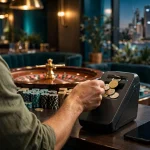
- Roulette Online: Wheel Variants and Number Layouts
- Poker at the Table: The Aim of the Game
The Legal Boundary for Online Table Games in Australia
The Interactive Gambling Act 2001 sets the central legal boundary for real-money online casino games in Australia. Section 5 prohibits operators based in Australia from offering interactive casino games for money to residents. The prohibition covers online table games as well as other casino-style services; changing the game format does not change the legal classification.
The distinction between a locally based operator and an offshore one matters, but it is not a route around the law. The Act prohibits providing these services to people in Australia, and the legal framework treats online casino-style games offered to customers here as prohibited interactive gambling services. An operator’s foreign location or licence does not make its service lawful for the Australian market. Claims that Australians can use international casinos because the law does not apply offshore confuse where a company is based with whom it is offering a service to.
The compliance consequences fall on operators and other relevant entities, not on an individual merely for playing. The stated maximum daily penalties under the Act are A$360,000 for an individual who violates it and A$1.8 million for a body corporate. Those figures concern people or entities responsible for violating the law; they do not establish a player fine for using an offshore site. The practical distinction is therefore not “local is prohibited, offshore is permitted”. It is that the law bars the provision of the service to people in Australia, while enforcement can involve operators and platforms beyond the country.
For real-money casino table games in Australia, practical details such as licensing and payment options can help you decide what to check before playing. Use these operator notes as a concise reference, and verify the current terms directly with each casino.
1. Kingmaker
Payout speed: crypto ~90 minutes, fiat 1-5 days · Min. deposit: A$30 Kingmaker lists crypto payouts at around 90 minutes and fiat payouts at 1–5 days. The minimum deposit is A$30.
2. Roby Casino
License: Curacao eGaming (Roby Games Ltd) Roby Casino is licensed by Curacao eGaming under Roby Games Ltd.
3. DragonSlots Casino
License: Curacao Gaming Authority (Jumpman Gaming Ltd) DragonSlots Casino is licensed by the Curacao Gaming Authority under Jumpman Gaming Ltd.
4. SkyCrown
License: Tobique Gaming Commission · Payout speed: crypto ~10-15 minutes, fiat 1-5 days · Min. deposit: A$30 SkyCrown is licensed by the Tobique Gaming Commission. Its listed payout times are around 10–15 minutes for crypto and 1–5 days for fiat; the minimum deposit is A$30.
5. Wild Tokyo
License: Curacao · Payout speed: crypto 30-60 minutes, fiat 1-5 days · Min. deposit: A$10 Wild Tokyo is listed as Curacao-licensed, with crypto payouts taking 30–60 minutes and fiat payouts 1–5 days. Its minimum deposit is A$10.
6. LuckyVibe
License: Curacao Gaming Control Board OGL/2023/176/0095 (Hollycorn N.V.) LuckyVibe is listed under Curacao Gaming Control Board licence OGL/2023/176/0095, held by Hollycorn N.V.
7. Neospin
License: Curacao Gaming Control Board OGL/2023/176/0095 (Hollycorn N.V.) Neospin is listed under Curacao Gaming Control Board licence OGL/2023/176/0095, held by Hollycorn N.V.
8. House of Pokies
License: international iGaming licence – jurisdiction not named in the source · Payout speed: PayID 1-24 hours · Min. deposit: A$30 (PayID from A$10) House of Pokies lists an international iGaming licence, but the jurisdiction is not named. PayID payouts are listed at 1–24 hours; the minimum deposit is A$30, or A$10 when using PayID.
9. Lucky Dreams
License: Curacao · Min. deposit: A$20 (POLi) Lucky Dreams is listed as Curacao-licensed. Its minimum deposit is A$20 with POLi.
10. Thor Casino
License: Curacao – Antillephone N.V. (Versus Odds B.V.) · Min. deposit: EUR 20 Thor Casino is listed as Curacao-licensed through Antillephone N.V. (Versus Odds B.V.). Its minimum deposit is EUR 20.
The Australian Communications and Media Authority (ACMA) is responsible for enforcing compliance. Its work includes blocking unlicensed domestic platforms, and Australian authorities actively enforce restrictions on prohibited online casino services. A site appearing online, accepting registrations or displaying a foreign licence is not proof that it is authorised to offer real-money table games in Australia. Nor does the ability to reach a page establish that the service is lawful or stable: access and legal status are separate questions.
This makes the phrase “online casino table games for real money” more complicated than a description of the product. A real-money game may look like an ordinary digital service, but the legal issue is the operator’s provision of interactive gambling to people in Australia. A live stream, a digital interface or a foreign company address does not by itself alter that issue. Free-play demonstrations are a different question from wagering for money; the legal boundary described here concerns real-money services, not the mechanics or quality of a game.
Promotional terms add a separate financial calculation, but they do not change the legal position. A specialist review gives a straightforward illustration: an A$100 bonus with a 30-times wagering condition requires A$3,000 in qualifying bets before withdrawal. That is a turnover condition, not a promise that A$3,000 will be lost or returned. The balance after wagering depends on outcomes, while the condition determines how much qualifying activity must occur before cashout is permitted.
Casino Games: Pokies, Slots and Table Games · Seven-reel slots in Australia: features and rules
The amount of wagering credited can also depend on the game. A specialist review reports that table games such as blackjack or roulette may contribute only 10–20% toward a bonus condition, or may be excluded. If a game contributes less than the full stake, the required qualifying turnover takes longer to accumulate than the headline multiple alone suggests. The operator’s terms determine the actual treatment, so a bonus figure without its game-contribution rules is an incomplete price.
A specialist review also describes bonus wagering caps commonly set at A$5–A$10 per hand or spin, with exceeding the cap potentially voiding the bonus and associated winnings. That reported range is not a universal Australian rule. It is a term to check in any offer’s conditions, alongside eligible games, contribution rates, expiry and withdrawal restrictions. An offer can therefore carry a substantial effective cost even before the legal status of the service is considered.
These calculations are not an endorsement of an offer or a way to make prohibited services lawful. A bonus changes the conditions attached to funds; it does not change whether an operator may provide real-money casino games to people in Australia. For the same reason, a ranking or promotional claim about the best table-game offer cannot resolve the legal question. The governing boundary remains the Act’s restriction on providing online casino gambling to customers in Australia, regardless of whether the operator is based locally or offshore.
Legal Warning
The Interactive Gambling Act 2001 prohibits operators from providing interactive casino games for real money to people in Australia, regardless of whether the operator is based locally or offshore.
Bitcoin Table Games: What the Available Facts Can—and Cannot—Establish
Bitcoin does not, by itself, define a table game. The name of a payment method cannot establish which games are offered, how a hand or round works, how outcomes are determined, or what terms apply to a balance. Those are separate features. Treating a game as different simply because a site mentions Bitcoin would confuse payment arrangements with game mechanics.
The phrase “Bitcoin table games” can therefore describe an association between a cryptocurrency and a casino service, but it does not identify a distinct class of games. Nor does it establish that a particular table game is available, that a deposit can be made in Bitcoin, or that winnings can be withdrawn in it. Each of those points depends on the actual service and its conditions. A label is not a transaction record.
A specialist casino review has described cryptocurrency withdrawals as taking 10–30 minutes, with processing dependent on blockchain confirmations. That is a report from one review, not a reliable timing promise for every operator, transaction or cryptocurrency. It also does not establish Bitcoin-specific processing terms or show that a table game is involved. Withdrawal speed cannot be inferred from a game’s name, and a claimed processing time is not the same as the time funds become usable.
Aristocrat Online Pokies in Australia: What to Know
Bitcoin and conventional table-game terms
A comparison of Bitcoin table games with conventional casino table games needs a defined point of comparison. If the comparison concerns the rules, Bitcoin alone supplies no basis for saying they differ. If it concerns odds, the currency label supplies no odds information. If it concerns payment, the relevant details are deposit and withdrawal methods, fees, exchange treatment and account conditions—none of which can be read from the game category.
The same distinction applies to questions about the “best” Bitcoin table game or a table game with the “best odds.” “Best” needs a stated measure. It might refer to rules, ease of understanding, a published return figure, or another criterion, but Bitcoin does not settle any of these. A payment method cannot substitute for comparative game data. Without a common measure and dependable figures, ranking one option above another would be false precision.
Table layouts and equipment are also separate from currency. Felt, a digital interface, or a table-style presentation may describe how a game looks, not how it is funded or what its financial terms are. Likewise, a game being open on a screen does not establish that a Bitcoin balance can be used for it. Presentation, availability and payment are distinct questions.
In Australia, the legal boundary for real-money online casino services remains relevant regardless of whether a service refers to Bitcoin or another payment method. The payment label does not change the status of the underlying service. A cryptocurrency reference should not be read as evidence that a casino service is lawful to provide to people in Australia or that it is accessible to them.
Bitcoin Payment
Cryptocurrency references in a game’s name or service do not change the game’s mechanics, odds, or the legal status of the service in Australia.
For a careful comparison, the useful categories are therefore separate: the game’s rules and outcome method; any stated game-specific odds; the payment and withdrawal conditions; and the legal status of the service. Bitcoin alone answers none of those questions. That is less exciting than a “best” label, but it is also the only conclusion the label can support.
Table-Game Odds: What Can Be Compared Without Inventing an Edge
A ranking of casino table games by odds needs comparable figures. Without reliable return percentages or house-edge calculations for each game under defined rules, labels such as “best odds” and “worst odds” are not conclusions; they are unsupported rankings.
The term odds can refer to different things. It may describe the chance of an outcome, the payout attached to a winning bet, or the game’s expected return over time. These measures are related, but they are not interchangeable. A larger payout does not by itself mean a better chance of winning, and a bet that wins frequently is not necessarily more favourable over repeated play.
A house edge is also conditional, not a fixed property that can be compared without context. Its calculation depends on the rules, the available bets and how those bets are settled. A meaningful comparison would need those conditions to be stated consistently for every game. Otherwise, a chart may place unlike figures side by side and create the appearance of precision without a fair basis for the ranking.
Dragon Link Online Pokies in Australia: What to Know
That is why a “casino table games house edge chart” should be treated cautiously unless it explains its method and the rules behind each figure. A chart that omits those details cannot establish which option has the strongest expected return. Nor can a broad category label stand in for a calculation: the same named game can be offered under different rules.
The same limits apply to searches for the best table games at a casino or the table games with the best odds. There is no defensible universal winner in the absence of like-for-like calculations. Calling one game the best, or another the worst, would turn missing comparisons into a confident claim. The arithmetic does not improve because the heading is decisive.
A useful comparison would state what is being measured, identify the relevant rules and use figures calculated on the same basis. It would also separate a theoretical long-run return from the result of a particular session. A long-run measure describes an expectation across repeated play; it does not predict the outcome of an individual hand, roll or spin. Short-run results can vary, so a favourable-sounding percentage would not function as a promise about a session.
For a money decision, the practical distinction is between a measurable edge and presentation. A game title, an attractive payout, or a claim of favourable odds is not enough to establish expected value. Without comparable calculations, no ranking of the best odds at casino table games—or of the worst—can be made responsibly. That is a limit on the comparison, not evidence that every game has identical odds.
Attention: A house edge is conditional and depends on specific rules and bets; a general chart without these details cannot establish which game has the strongest expected return.
Playing Online: Live Dealers, RNGs and Free-Play Expectations
The main difference between online table-game formats is how the action is produced. A live-dealer game shows a real dealer using real casino equipment, with video streamed to players. In an RNG version, software determines the relevant outcome: for example, which cards are dealt or where a roulette ball lands. The screen may present a similar betting interface, but the underlying process is not the same.
In the live format, the video feed is central to the experience. The dealer and equipment are physically present, while the player views the action remotely. The stream shows the game as it is conducted; it does not mean the player is at the casino or handling the equipment. The delivery method is therefore a broadcast of a real table in progress.
An RNG game replaces that visible physical process with a software-generated result. Cards or a roulette outcome are determined electronically rather than by the dealer and equipment shown in a live stream. The interface may still display cards, a wheel or other table imagery, but those graphics do not make the outcome a live event. The relevant distinction is the source of the result, not how realistic the screen looks.
This distinction matters when interpreting labels such as “live,” “online” or “free play.” “Live” describes the streamed dealer format; “online” alone does not establish that a real dealer is involved. Conversely, a game presented through animated graphics may be an RNG version even when its layout resembles a physical table.
Best-Paying Online Pokies in Australia: What Terms Show
Free play describes a different question: whether a mode involves real-money wagering. It does not identify how outcomes are generated. A no-cash mode, where available, could still use software to determine outcomes; the words “free play” do not establish that a dealer, live stream or physical equipment is part of the game. Nor does a free-play label establish that a particular game or mode is available in Australia. The format and the money status are separate characteristics.
For someone trying to learn how table games work, those categories should not be treated as interchangeable. A streamed dealer provides a view of a real table process. An RNG version presents outcomes determined by software. A free-play mode, if offered, concerns the wagering arrangement rather than the delivery mechanism. One label cannot safely stand in for the others.
The same point applies to searches for popular games or the best table games to play. Popularity does not tell whether a game is live or RNG-based, and a “best” label does not explain how its outcomes are produced. The format can be assessed without making claims about which game is preferable: identify whether the screen shows a streamed dealer or a software-generated result, then distinguish that from whether money is involved.
These terms describe presentation and outcome generation, not permission to access a service. In Australia, real-money online casino games are prohibited under the Interactive Gambling Act 2001. A description of live streaming, RNG operation or free-play terminology is not an invitation to use an online casino.
Finding a Nearby Casino with Table Games
A search for a nearby casino is about a physical venue, not an online table-game page. “Near” depends on the starting point and the practical route: a venue that appears close on a map may take longer to reach than one farther away. Distance alone therefore does not establish which casino is the closest in usable terms.
Verifying a Venue
- Confirm the street address identifies a physical casino.
- Verify that the venue identifies table games specifically.
- Check that the information relates to present operations.
- Ensure the available route makes the visit practical.
The location attached to a result matters. A listing may refer to a city, a suburb or a broad service area rather than the entrance of a casino. For a meaningful comparison, the venue’s street address and the route from the relevant starting point need to match. A name appearing in a local result is not, by itself, confirmation that the venue is nearby.
The same distinction applies to table games. A casino’s general description does not establish which games are available at a particular venue, or whether its listed offering reflects current operations. A table-game label may cover different forms of play, so the category alone is not a complete description. Venue-specific information is needed before treating a listing as a match for a particular game or format.
What a local listing can establish
A result can be useful as a lead, but separate details should be assessed separately:
- Location: whether the address identifies a physical casino and supports the claimed proximity.
- Offering: whether the venue itself identifies table games, rather than relying on a broad casino label.
- Current status: whether the information relates to present operations, rather than an old directory entry or an announcement.
- Access: whether the stated location and available route make the visit practical.
These checks avoid treating a search label as a complete account of a venue. A nearby result may not provide enough detail to establish both that it is a casino and that table games are part of its current offering. Conversely, an accurate game description does not make a venue local.
Terms such as “new casino” need the same care. “New” may describe a recently opened venue, a newly announced project or simply a recently updated listing. Those are not equivalent. A result’s wording does not establish an opening date or confirm that table games are operating there. The distinction is material when deciding whether a destination is available now rather than planned or described in advance.
Location-specific searches also depend on the place entered. References to another country, state or city should not be treated as evidence about Australian venues. A result can be geographically relevant only when its address corresponds to the intended area. City names and venue names can recur, so the address is a more useful identifier than the name alone.
The practical comparison is therefore not just “closest casino,” but closest confirmed physical venue that matches the required table-game category. Proximity, venue identity and game availability are separate pieces of information. Treating them as separate keeps a broad local result from being mistaken for a verified destination.
What Counts as a Casino Table Game
A casino table game is defined by the action around a wager, not simply by the presence of a table. The player stakes money on a hand or another outcome, then the result is determined by the game’s rules. In a card-based format, that can mean comparing a player’s hand with a dealer’s. In a dice-based format, the wager concerns the result of a roll. The shared feature is a bet linked to a defined outcome.
Table Game Basics
- A table game is defined by a wager linked to a defined outcome.
- Mechanics vary between player-versus-dealer and outcome-based betting.
- The delivery method does not change the underlying game rules.
The mechanics vary, so “table game” is a category rather than one set of rules. A player-versus-dealer hand is one basic structure. In blackjack, for instance, the player competes with the dealer to finish with a hand value closer to 21. The aim is not to beat another player’s hand; the dealer is the opponent specified by the game.
Other betting structures focus on which hand or result will prevail. Depending on the format, a wager may be placed on the player’s hand, the Banker’s hand or a tie. These are distinct outcomes, and the bet determines which one matters for that round. A wager on a tie is not the same as betting on either hand: it depends on the two sides ending level.
Dice-based play has a different mechanism. Players roll a pair of dice and bet on the outcome. The roll supplies the result, while the wager identifies the event or result covered by the bet. That is enough to distinguish this structure from a hand comparison, even though both belong to the broader table-game category.
The practical way to classify a game is to identify three parts: what is being wagered on, how the outcome is produced, and what counts as a winning result. A hand game turns on the value or status of hands. A dice game turns on a roll. A bet on one hand, another hand or a tie names the outcome being backed. Without those parts, the word “table” says little about the actual play.
New Australian Online Pokies: Understanding the Claims
This definition also separates a game’s mechanics from its delivery method. A table game may be presented in different ways, but the central question remains whether play is organised around a hand or outcome and a wager on it. The table itself is scenery; the rules and settlement of the bet do the accounting.
Not every game involving cards or dice automatically fits the same structure. The decisive point is the relationship between the player’s wager and the stated outcome. For a hand-based game, that may be the player’s position against a dealer or a bet on one of the available hands. For dice-based play, it is the result of the roll. The category is broad, but its working parts are concrete: a defined contest or event, a stake, and an outcome that settles the wager.
Live Table Games: How the Format Works
A live table game is presented through a video stream showing a real dealer working with real casino equipment. The defining feature is the source of the action: the table activity is happening with a person and physical equipment, rather than being represented solely by a digital table interface.
The stream carries that activity to players viewing remotely. In this sense, “live” describes how the game is delivered, not a separate category of table-game rules. A live casino table game still centres on a dealer and a table; the screen provides the view of that setting. The format does not, by itself, specify which games are offered or what their rules are.
Live Dealer
Uses a video stream to show a real dealer and physical equipment in real-time.
RNG Version
Uses software to determine outcomes electronically, regardless of the visual interface.
Free Play
A wagering mode that does not involve real money, which may use either RNG or live delivery.
This distinction helps make sense of labels such as “live dealer” and “live table games.” They refer to a streamed presentation involving an actual dealer and casino equipment. They do not establish that every table game is available in this format, or that every service using the label operates in the same way. The essential point is the live video feed, not a promise about the range of tables or the conditions attached to play.
A casino table card games list, for instance, is a different kind of information from a description of live delivery. A list names or categorises games; “live” identifies the presentation method. The phrase “best” adds no reliable measure on its own: a format label cannot establish quality, value or suitability. Those judgments require criteria beyond the fact that a dealer and equipment appear in a stream.
The format should also be kept separate from the question of physical location. A streamed table is viewed remotely, but the video does not turn it into a nearby venue or show that a particular local casino provides it. Nor does the presence of a real dealer settle whether an online service may lawfully offer real-money play to people in Australia. Under the Interactive Gambling Act 2001, providers are prohibited from supplying real-money online casino games to people physically located in Australia.
So, the practical meaning of “live” is narrow: real dealer, real casino equipment, and video streamed to players. It describes what the presentation shows, not the legality of access, the available game catalogue, or the terms of play.
Lightning Link Online Pokies in Australia: What’s Allowed
Card-Game Mechanics: Hands, Bets and Outcomes
Card games at a table can be understood through two basic elements: the hands in play and the outcome a wager covers. In some formats, a player’s bet is tied to a hand rather than to a particular card or individual event. The result is then assessed by comparing the relevant hands or determining whether the stated outcome occurred.
One betting structure offers a choice among the player’s hand, the Banker’s hand, or a tie. These are separate outcomes, not different ways of describing the same wager. A bet on a hand depends on that hand being the one that wins; a tie bet depends on the hands ending level. The labels identify what the wager covers, but they do not by themselves establish the rules used to resolve the hands.
That distinction matters when reading a table’s instructions. A betting option names the outcome, while the game’s rules determine how the outcome is decided. The presence of a Banker’s hand does not mean a player is wagering against a bank in the financial sense; it identifies one side of the game. Likewise, a tie is a possible result, not an assurance that either side has an advantage.
Other card formats centre on building a strong hand. Poker, for instance, is based on players competing to make the best possible hand. That broad objective can be stated without assuming that every poker table uses identical rules or betting arrangements. The hand is the basis of comparison; the particular table rules determine how hands are formed and judged.
Do
- Distinguish between a bet on a hand and a bet on a result.
- Use the specific table rules to determine how hands are assessed.
Don’t
- Assume a “Banker” bet implies a financial bank.
- Assume the bet label alone explains the probability of winning.
For a card-table wager, the useful distinction is therefore between a bet on a hand and a bet on a defined result. A player-hand, Banker-hand, or tie selection specifies the outcome being backed. A competition to form the strongest hand instead makes the relative quality of the hands central. These mechanics describe what the wager concerns, not the probability of winning or the value of a particular choice.
The table rules remain the operative terms. They define how hands are assessed and what counts as a winning result; the bet label alone cannot answer those questions. A clear reading separates the selection being made from the rule that settles it.
Roulette Online: Wheel Variants and Number Layouts
Online roulette is offered in several versions, with the wheel’s numbered spaces providing the clearest distinction. European, French and American roulette are the main formats. European and French wheels have 36 numbered spaces and a green zero; the American wheel has those numbered spaces plus a green double zero.
3-Reel Slots in Australia: Bonuses, RTP and Rules
The difference is visible in the layout, not in the name alone. A single-zero wheel has one green space marked 0. A double-zero wheel has two green spaces, marked 0 and 00. That additional space is the defining layout difference between the American version and the European and French versions.
European and French roulette share the same stated number count and zero arrangement. Their names remain separate because they are recognised as distinct versions, but the shared layout means the wheel’s visible numbering does not distinguish them. American roulette is easier to identify at a glance: its green 00 sits alongside the green 0.
These details help make sense of a roulette table’s layout before considering any other rules shown for a particular game. The labels European, French and American identify variants; the number spaces show what changes on the wheel. A single zero or a double zero is a concrete feature, unlike a title or decorative theme.
Crash Casino Games in Australia: Rules and Access
Roulette is one of the casino table games presented online, but its format should not be inferred from appearance alone. The useful check is the wheel itself: whether it displays a green 0 only, or both 0 and 00. For European and French roulette, the stated layout is 36 numbered spaces with a green 0. For American roulette, the green 00 is also present.
That comparison describes the wheel configuration, not a recommendation or a claim about which version is more favourable. The distinction is purely structural: European and French share the single-zero layout, while American roulette uses the double-zero layout.
Poker at the Table: The Aim of the Game
Poker is built around a contest to make the best possible hand. That objective distinguishes its central idea from a game described only by a player’s effort to beat a dealer: the focus is on the strength of the hands competing at the table.
5-Reel Slots in Australia: Features, RTP and Play
The phrase “best possible hand” refers to the game’s ranking system. A hand is assessed against other hands, and the aim is to finish with the strongest one under the rules in use. The objective is straightforward; the precise way a particular version reaches an outcome depends on its own rules. The broad label “poker” alone does not specify those rules or establish that every poker format is played in the same way.
This distinction matters when casino poker table games are considered as a category. The name identifies a family of games centred on hand-building, not one universal set of steps. A title or table description should therefore be read as identifying a particular format, rather than as proof that its dealing, betting or hand-ranking details match another poker game. No specific variant can be inferred from the general objective alone.
For anyone comparing descriptions of poker at a casino table, the useful starting point is the stated aim: players compete to build the strongest possible hand. That is the common thread. Details beyond it belong to the individual game’s rules, not to poker as a general label. The distinction keeps the basic concept clear without treating every game carrying the poker name as interchangeable.
Can you play table games online for real money?
No, not through a service lawfully offered to people in Australia. The Interactive Gambling Act 2001 prohibits providing real-money online casino games to Australian customers, including table games.
How long do withdrawals typically take from offshore casinos to Australian bank accounts?
Direct bank transfers can take 3–7 business days. E-wallet withdrawals are reported to take 2–24 hours, while cryptocurrency withdrawals may take 10–30 minutes, subject to blockchain confirmations.
What is the legal status of online table games for Australian players in 2026?
Real-money online table games offered to people in Australia are prohibited under the Interactive Gambling Act 2001, whether the operator is based locally or offshore. ACMA enforces the restrictions.
Are online casinos legal in Australia?
Real-money online casinos cannot lawfully offer their services to people in Australia. A foreign location or licence does not make an offshore casino authorised to serve Australian customers.
Casino Games

Aristocrat Online Pokies in Australia: What to Know
A brand reference alone does not verify a game, its online version, Australian access or...

3-Reel Slots in Australia: Bonuses, RTP and Rules
A practical look at paytables, bonus triggers, configured RTP, access limits and what long-run return...

5-Reel Slots in Australia: Features, RTP and Play
Bonus rules, configured RTP, free-play options and availability help explain what five-reel slots offer—and what...

Seven-reel slots in Australia: features and rules
Seven-reel labels describe game structure, while bonus triggers, free-play limits and Australian access rules raise...

Bonus Buy Slots in Australia: RTP and Free Play
Explore how bonus-buy rules, RTP settings and demo play shape what a slot’s theoretical return...

High-Volatility Slots in Australia: How They Work
Volatility describes the distribution of wins, while independent RNG spins mean past results cannot forecast...

Low-volatility slots in Australia: how payouts work
Low volatility describes a pattern of more frequent, smaller wins, not a guarantee that spins...

New Australian Online Pokies: Understanding the Claims
A game’s claimed release date does not determine whether an offshore real-money casino can lawfully...

Best-Paying Online Pokies in Australia: What Terms Show
A practical look at offshore conditions, Bitcoin payments and the limits of using published terms...

Pokie Machines in Australia: Laws, Odds and Risks
The guide explains Australian restrictions, paytables, bonuses, volatility and RTP without treating any title or...

Progressive Jackpot Slots: How Pools and Triggers Work
Progressive prizes grow from eligible real-money wagers, while contribution rates, trigger rules and payout conditions...

RTP Slots in Australia: Understanding Long-Run Returns
RTP describes a game's expected performance across extensive play, while individual spins and short sessions...

Video Slots in Australia: Spins, RTP and Play Modes
Each spin has an independent RNG result; paytables, RTP settings, stake terms and play modes...

Bitcoin Pokies in Australia: Session Value Explained
Game credits show a session balance, but their Bitcoin equivalent depends on the game's settings...

Casino Dice Games in Australia: Rules and Legal Limits
A practical overview of dice formats, play mechanics, risk claims and the legal limits on...

Crash Casino Games in Australia: Rules and Access
A practical guide to game rules, Australian access, payment checks, free-play claims and the evidence...

Dragon Link Online Pokies in Australia: What to Know
A careful look at what the terms establish—and what they do not—about online play, app...

Lightning Link Online Pokies in Australia: What’s Allowed
The guide distinguishes venue machines from online offers and explains virtual-currency play, Hold and Spin...

Online Live Baccarat in Australia: Rules and Legal Limits
The guide connects Australia’s legal boundary with live-dealer formats, hand rules, scoreboards, stakes and practical...

Live Blackjack Online Casinos in Australia: Legal Guide
The guide separates Australia’s legal position from claims about sessions, deposits, strategy and game rules...

Live Roulette in Australia with English-Speaking Dealers
This guide explains Australia's online casino restrictions and how roulette rules, odds, table layouts and...

Mines Casino Game in Australia: Key Checks
The guide separates Mines from slot games and explains what demos, bonus wagering, cashout terms...

Plinko Casino Australia: Access, Terms and Payments
The guide distinguishes Plinko and slot listings, then examines access limits, withdrawals, verification, free play...

Pokies Tips and Tricks: Odds, Budgets and Bonuses
A practical guide to the limits of strategy, session costs, bonus terms and game features...

Real Cash Online Pokies in Australia: How They Work
Free-play results are not cash, while real-money play puts funds at risk and is governed...

Safe Online Pokies in Australia: Offshore Risks
A practical look at offshore licensing, payment evidence, delayed withdrawals, deposit errors and the limits...