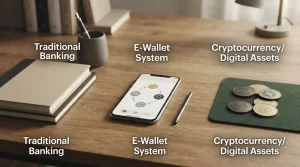
Wild Tokyo payment methods and AUD banking
 Available in AU
Wild Tokyo uses a hybrid cashier, combining conventional payment methods with cryptocurrencies. Australian-dollar balances are part of the account-currency offering. That combination gives different routes into and out of a casino balance: card and e-wallet deposits, bank or e-wallet cashouts, and cryptocurrency transfers. The key distinctions are the rail being used, its currency, the transaction’s minimum amount and the separate steps involved in withdrawal.
Table of Contents
Fiat balances and crypto transfers share the cashier
Wild Tokyo’s broader payment range includes Visa, Mastercard, Skrill, Neteller, PaysafeCard, bank transfer, MiFinity, Revolut, Jeton and Rapid Transfer. The AUD deposit list includes Visa, PaysafeCard, Skrill, Neosurf, MiFinity, CashToCode, Neteller, CASHlib and cryptocurrency. The AUD withdrawal list includes bank transfer, MiFinity and cryptocurrencies.
These payment routes differ in what moves. An AUD-denominated account balance expresses the casino amount in Australian dollars. A card or e-wallet transaction can involve an account currency and a payment-provider currency; the provider’s conversion conditions affect the final amount charged or received. A crypto transaction moves an asset with a market price that can change independently of the AUD amount used to value the balance.
For that reason, “supports AUD” and “accepts crypto” are separate characteristics. An Australian-dollar display does not turn a digital asset into a fixed-value Australian-dollar transfer. Likewise, a cryptocurrency symbol does not determine which chain or address format a particular transaction uses. The receiving details and the sending wallet’s selected network must match, and a mismatched transfer can be irreversible.
The AUD cryptocurrency list includes BTC, ETH, DOGE, LTC, USDT and XRP. The wider international asset list also includes SOL, TRX, USDC, BCH, ADA and TON. The AUD list is narrower; assets in the larger range should not be assumed to appear under every payment profile.
Cryptocurrency payment reference
The same cryptocurrency can have different sending or receiving arrangements depending on wallet and service. Network labels below are reading instructions, not an assertion that a particular blockchain network is supported at Wild Tokyo. The AUD cryptocurrency withdrawal range covers a group of coins, not fixed thresholds for every named token.
| Coin | Network | Min Dep | Min WD | Speed | Fee |
|---|---|---|---|---|---|
| Bitcoin (BTC) | Match receiving details | Per method | Crypto range: about A$80–A$90 | Processing and transfer conditions | Review transfer quote |
| Ethereum (ETH) | Match receiving details | Per method | Crypto range: about A$80–A$90 | Processing and transfer conditions | Review transfer quote |
| Dogecoin (DOGE) | Match receiving details | Per method | Crypto range: about A$80–A$90 | Processing and transfer conditions | Review transfer quote |
| Litecoin (LTC) | Match receiving details | Per method | Crypto range: about A$80–A$90 | Processing and transfer conditions | Review transfer quote |
| Tether (USDT) | Match receiving details | Per method | Crypto range: about A$80–A$90 | Processing and transfer conditions | Review transfer quote |
| XRP | Match receiving details | Per method | Crypto range: about A$80–A$90 | Processing and transfer conditions | Review transfer quote |
Cryptocurrency minimum withdrawals for the AUD profile are around A$80–A$90, depending on the asset. This is a category range, not a coin-by-coin schedule. In particular, stablecoin names such as USDT and market-priced coins such as BTC do not imply identical transfer conditions. Exchange movement, transaction charges and the size of the receiving amount are separate variables.
The Wild Tokyo overview includes an illustrative crypto-value calculation. It treats exchange-rate changes and transfer fees as user-entered scenarios, which makes it useful for understanding exposure without presenting hypothetical fees as Wild Tokyo charges.
Withdrawal thresholds depend on the destination
The AUD withdrawal selection includes bank transfer, MiFinity and cryptocurrencies. The corresponding minimums were A$15 for bank transfer, A$30 for MiFinity and approximately A$80–A$90 for cryptocurrency, with the crypto amount varying by coin. Those are materially different thresholds: a cashout amount that clears the bank minimum can still sit below the minimum for a wallet or crypto route.
Wild Tokyo’s Australian-dollar daily withdrawal cap is A$800. The figure describes an amount ceiling, not how quickly a payment arrives. It also operates at a different level from a method minimum. A cashout must be considered against the threshold for its route and any broader cap that applies to the account’s processing period.
- Bank withdrawal: A$15 minimum for the AUD withdrawal profile.
- MiFinity withdrawal: A$30 minimum in the same payment comparison.
- Cryptocurrency withdrawal: approximately A$80–A$90 depending on coin.
- Daily AUD cap: A$800, a ceiling separate from the method minimum.
Identity verification is a further stage. Wild Tokyo requires an identity check before withdrawal and can request identity documents. A transaction’s eligibility by amount does not, by itself, establish that documentary processing is complete. Conversely, completed document checks do not make every payment route share the same minimum or settlement process.
Individual withdrawal experiences can differ between payment routes and account circumstances. A method’s appearance in the selection does not supply a reliable individual arrival time. The withdrawal guide explores the method thresholds, A$800 daily limit, A$13,000 monthly figure and verification stage in a single cashout comparison.
How the A$20 deposit threshold fits the payment mix
The AUD cashier profile includes an A$20 minimum deposit. This is a reference for that profile, not a universal minimum for every card, e-wallet or cryptocurrency transfer. Payment services can apply different minimums, and the amount displayed for the selected rail is the operative transaction instruction.
A deposit minimum is also different from the balance that eventually remains after a transaction. When a card or e-wallet uses a currency other than the account’s displayed AUD, conversion can alter the payment-provider amount. When crypto is involved, the value of the asset can change before or after the transfer, and blockchain processing charges can affect the quantity received. Those mechanisms are part of how the payment type works, not evidence of a particular casino fee.
- Separate the units. Distinguish the AUD casino-account amount from the currency or token that moves through the payment provider.
- Read the method threshold. The A$20 AUD deposit figure is a reference point; a chosen rail may present its own transaction amount.
- Understand the conversion. Fiat currency exchange and crypto market value move through different mechanisms.
- Distinguish deposit and withdrawal. A deposit method in the AUD deposit list is not automatically the same as a withdrawal method.
- Allow for financial risk. Gambling can result in the loss of the deposited amount, while cryptocurrency introduces additional market and transfer risks.
The maths behind transaction differences is independent of whether the payment is used for gambling. For example, an illustrative account amount of A$100 subject to a hypothetical 5% asset-price decline would be worth A$95 before any transfer charges. That example describes arithmetic, not a published Wild Tokyo charge, current exchange quote or expected result.
Whether a transaction goes through a card, e-wallet, bank or cryptocurrency network also affects the personal information involved. Traditional rails can be associated with named financial accounts; crypto transfers require careful handling of addresses and network information. The account and verification overview explains why entering registration details and satisfying a withdrawal identity check are separate activities.
AUD deposits and withdrawals side by side
The AUD cashier profile has more deposit options than withdrawal options. That is a common structural distinction in multi-rail payment systems: funding and cashout flows are separate product capabilities. The table lists methods for each direction; a dash means the method is not listed for that direction in the AUD profile, not that it is impossible in every context.
| Method | Rail type | Deposit listed | Withdrawal listed | Australian-dollar note |
|---|---|---|---|---|
| Visa | Card | Yes | — | Card deposit selection |
| PaysafeCard / PSCard | Prepaid service | Yes | — | Prepaid deposit selection |
| Skrill | E-wallet | Yes | — | Wallet deposit selection |
| Neosurf | Prepaid service | Yes | — | Prepaid deposit selection |
| MiFinity | E-wallet | Yes | Yes | A$30 withdrawal minimum |
| CashToCode | Cash-voucher rail | Yes | — | Deposit selection |
| Neteller | E-wallet | Yes | — | Wallet deposit selection |
| CASHlib | Voucher service | Yes | — | Voucher deposit selection |
| Bank transfer | Bank rail | — | Yes | A$15 withdrawal minimum |
| Cryptocurrencies | Digital assets | Yes | Yes | Withdrawal range about A$80–A$90 by coin |
Broader Wild Tokyo payment listings include Mastercard, Revolut, Jeton and Rapid Transfer in addition to services in the Australian selection. The table distinguishes AUD-listed methods from the broader international range; a method in that wider range should not be assumed to appear in every cashier profile.
The contrast between MiFinity and bank transfer highlights why a generic “cashout minimum” would be misleading. The platform can present one account balance while different destinations require different minimum amounts. A player comparing historical transactions needs to preserve the selected method alongside the currency, rather than recording only the headline amount.
A payment route also has a practical data trail. Bank transactions carry account and transfer references; e-wallets have wallet-account identifiers; cryptocurrency transfers have destination addresses and transaction hashes. Those details matter when reconstructing what occurred, but they do not supply any guarantee of completion or recovery.
Questions about Wild Tokyo payments
Does Wild Tokyo use both fiat and cryptocurrency payments?
Yes. Wild Tokyo combines fiat payment methods with cryptocurrency support. Australian-dollar account balances are part of its payment model.
What is the Australian-dollar deposit minimum?
The AUD cashier profile lists an A$20 deposit minimum. The relevant threshold is tied to the payment method and currency shown for the transaction.
Which cryptocurrencies are included in the AUD payment list?
The AUD cryptocurrency list includes Bitcoin, Ethereum, Dogecoin, Litecoin, Tether and XRP.
Which withdrawal methods are listed for the AUD profile?
The AUD withdrawal list includes bank transfer, MiFinity and cryptocurrencies. Their minimum withdrawal amounts differ by rail.
What is the Australian-dollar daily cashout cap?
The Australian-dollar daily withdrawal cap is A$800. Withdrawal minimums and identity checks are separate conditions.
One AUD balance, several distinct transaction routes
Wild Tokyo’s banking structure is broad enough to include cards, vouchers, e-wallets, bank transfers and cryptocurrencies, with Australian-dollar balances supported. The important operational differences lie below that common account currency: deposit and withdrawal selections are not identical, minimums are route-specific, an A$800 daily cap applies to Australian-dollar cashouts, and identity verification can precede withdrawal.
For cryptocurrency, transaction-network accuracy and exposure to price movement add a layer that does not apply to a simple AUD account display. For fiat methods, payment-provider currency conversion and route-specific handling remain relevant. These distinctions explain the service more precisely than a single long list of method logos or a generic claim of fast payouts. Gambling itself carries the possibility of financial loss whatever the payment rail.